Skip to content

Fort Wayne

He was in the engagement

In 1843 the Fort Wayne Sentinel printed an old soldier's account of Harmar's defeat, copied from a journal he had kept for fifty-two years. One line of it puts Chief Richardville in the river that morning. Twenty-five years later the county's first history put the same man on the bank, a boy of ten or twelve, watching.
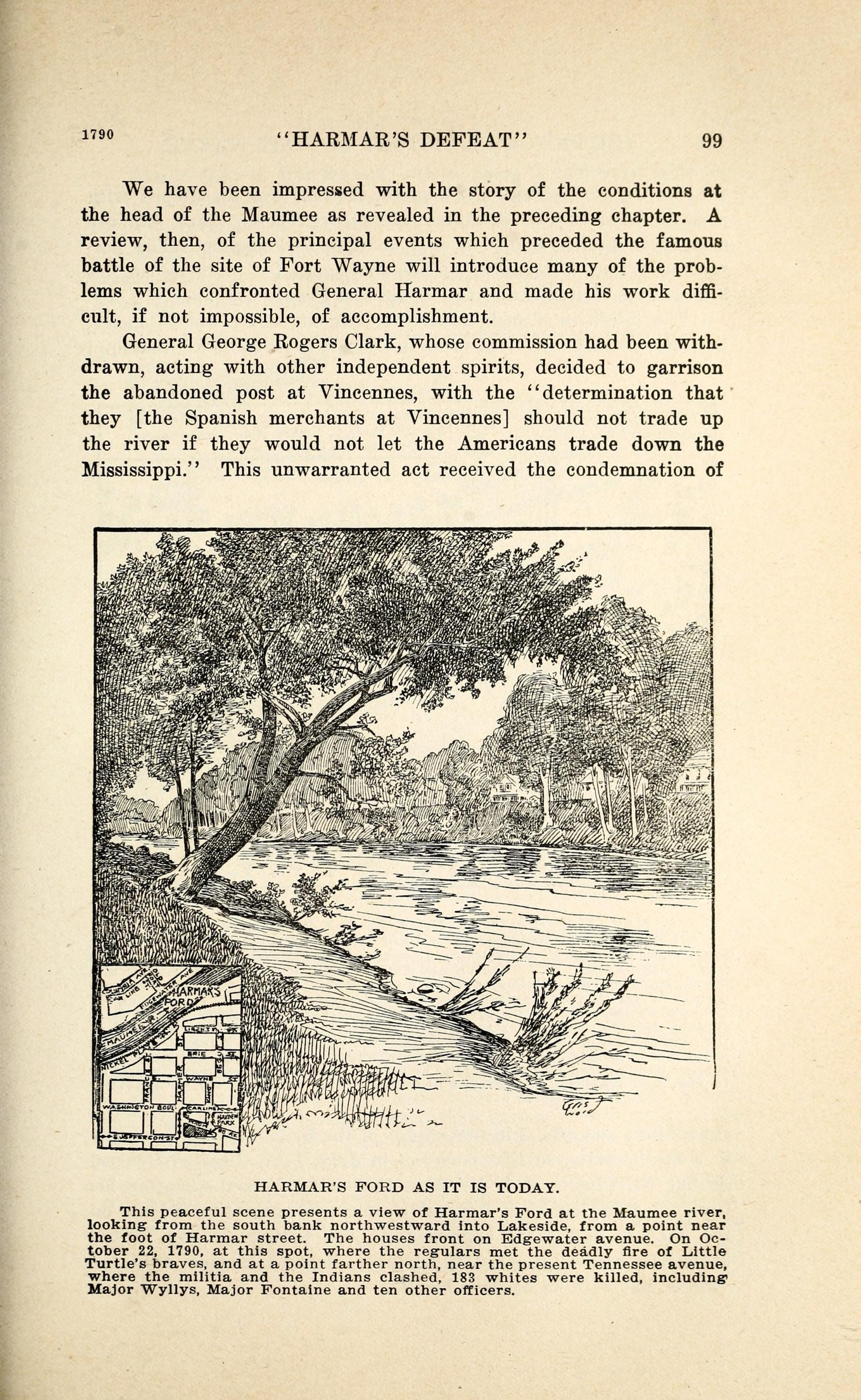
A printed page from a 1917 volume, numbered 99, with a running head in quotation marks. Below two paragraphs of text sits a pen and ink drawing of a river seen from a wooded bank, a large tree leaning out over the water from the left, houses among the trees on the far side, and a shelving gravel bar in the foreground. A small inset street map is set into the lower left corner of the drawing, and a signature is worked into the lower right. A caption in small capitals runs beneath it.

The Pictorial History of Fort Wayne, 1917, printed page 99, scan leaf n106, via the Internet Archive.
History

How this county was settled, named and fought over, read out of the county histories from Brice in 1868 to Griswold in 1917, the garrison orderly books, and the Fort Wayne Sentinel.

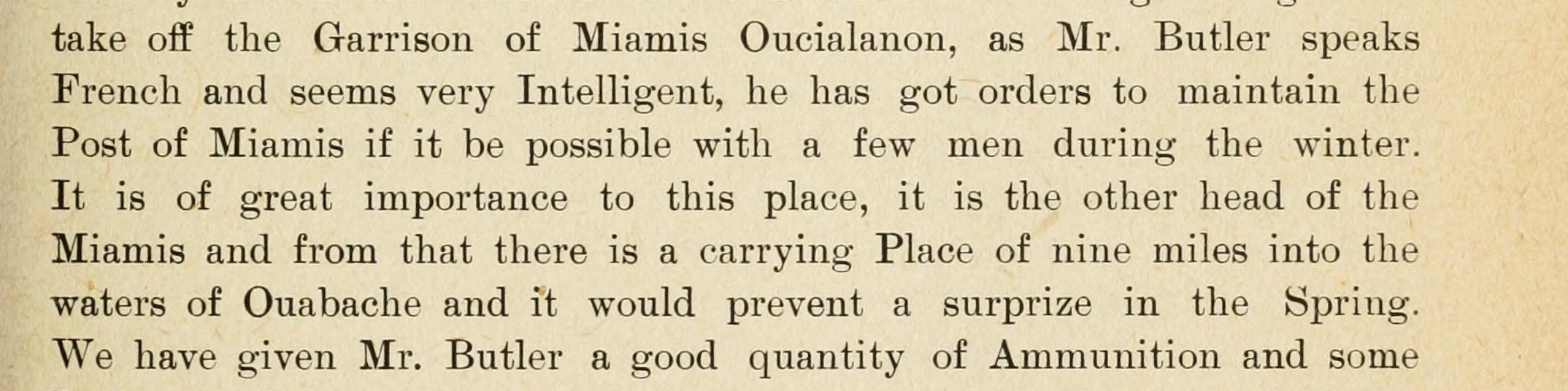
  • A printed page carrying Campbell's sentence that the post at the Miamis is of great importance, being the other head of the river with a carrying place of nine miles into the waters of the Ouabache.

    Fort Wayne

    A carrying place of nine miles

    In December 1760 the officer holding Detroit explained why a lieutenant had gone to keep the post at the head of the Maumee through the winter. He gave three reasons in one sentence. In 1917 a Fort Wayne historian quoted it and changed the only part about this ground.

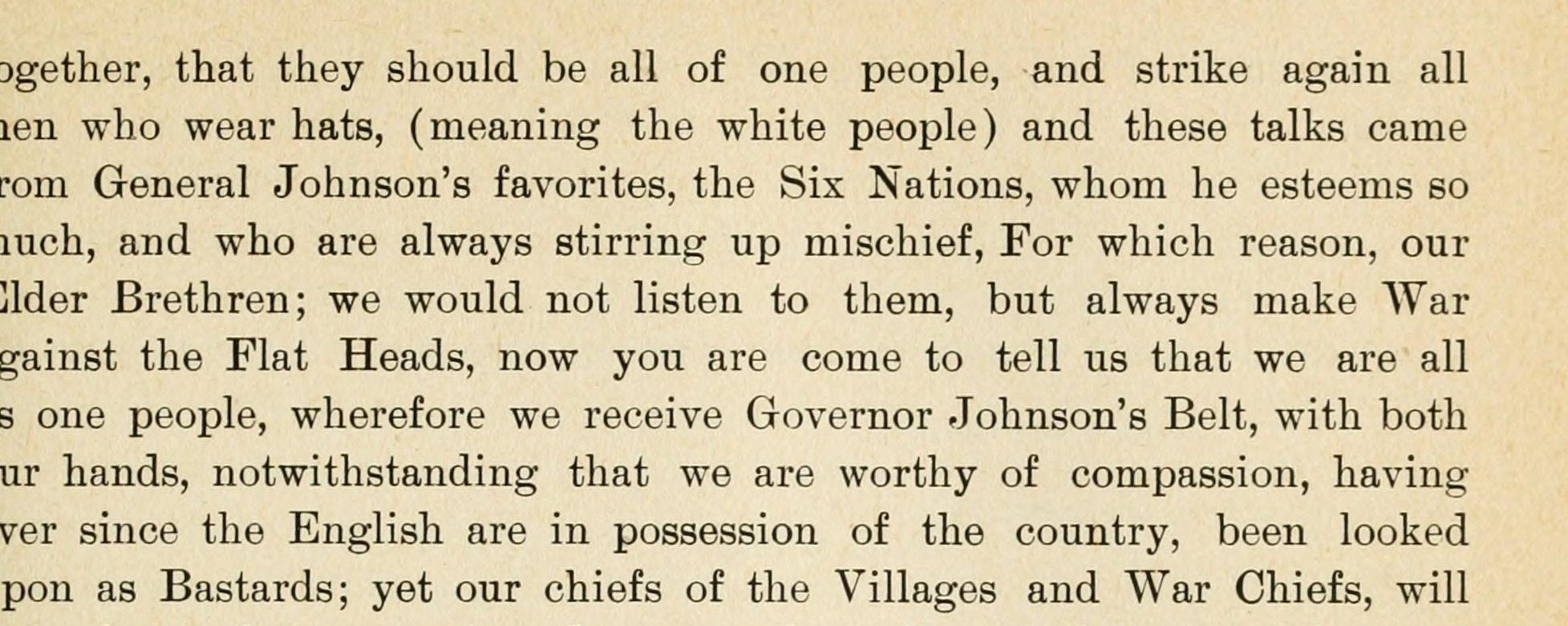
  • A printed page carrying the Miami answer, including the sentence saying the talks came from General Johnson's favorites, the Six Nations, whom he esteems so much, and the sentence saying they have been looked upon as Bastards ever since the English came into possession of the country.

    Beyond Allen County

    Looked upon as Bastards

    In August 1773 the Miami answered Sir William Johnson, and told his deputy that the mischief in the country came from the Six Nations, whom Johnson trusted most. Then they said what ten years of English possession had been worth to them.

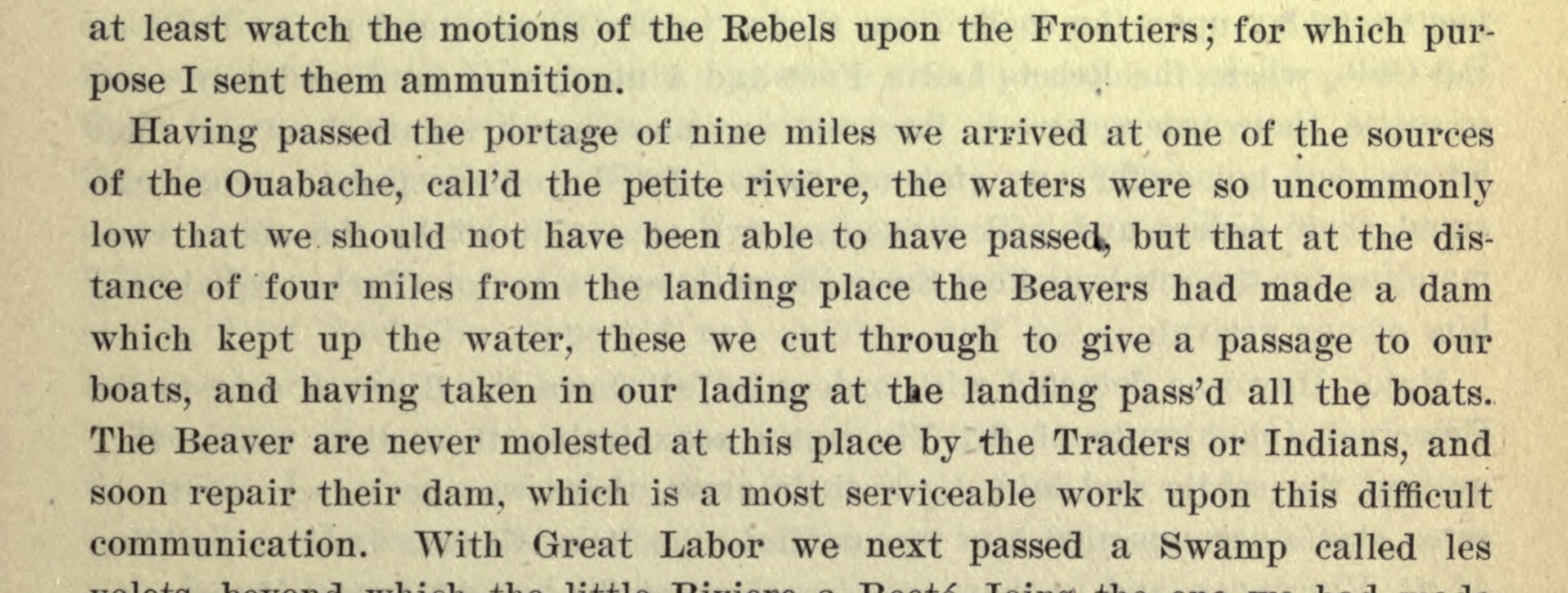
  • A printed page carrying Hamilton's account of passing the portage of nine miles and finding a beaver dam four miles from the landing place.

    Fort Wayne

    The beavers had made a dam

    A British force crossed the nine mile carrying place at the head of the Maumee in October 1778 and found the water beyond it too low to float the boats. What carried them down was a beaver dam, and the officer who cut it wrote down why nobody there touched the beaver.

All 26 pieces in History

Builders

The bridges, mills, towns and courthouses of Allen County, and the men who took the contracts.

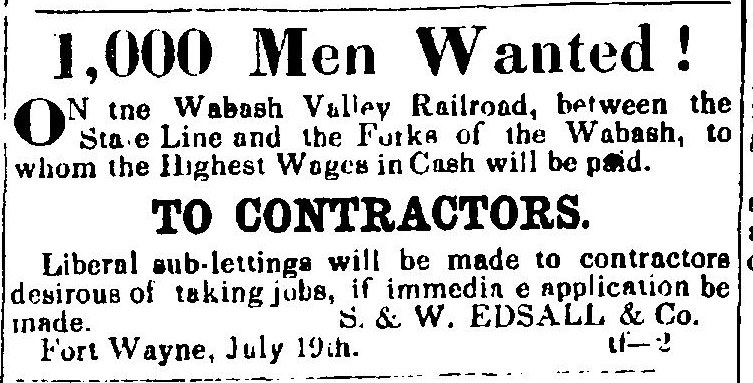
  • A newspaper advertisement headed 1,000 Men Wanted! in heavy type, on the Wabash Valley Railroad between the State Line and the Forks of the Wabash. Below, To Contractors, offering sub-lettings, signed S. and W. Edsall and Co., Fort Wayne, July 19th.

    Fort Wayne

    The Edsalls know no such word as fail

    In March 1844 Samuel Edsall asked Fort Wayne for a bridge over the St. Mary's and took the contract himself. He took the plank road to Bluffton partly in stock, and the second and third courthouses as contractor.

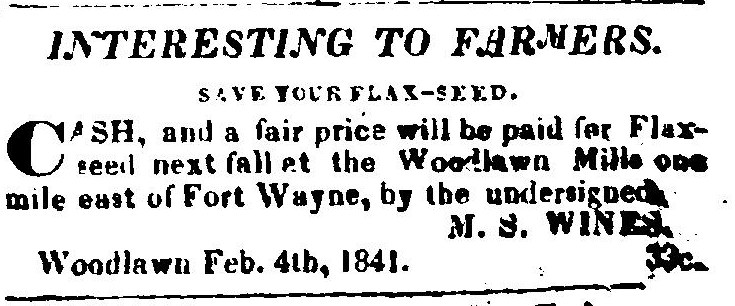
  • A small newspaper notice headed Interesting to Farmers, and Save your Flax-seed. Cash and a fair price will be paid for flax-seed next fall at the Woodlawn Mills one mile east of Fort Wayne, signed M. S. Wines, Woodlawn, Feb. 4th, 1841.

    Fort Wayne

    A spirit of enterprise

    Marshall S. Wines built a sawmill on Cedar Creek in 1834 and the Woodlawn Mills on the Maumee in 1838. In 1841 he went bail for another man's debt. By July 1842 the mill was late Col. Wines', and in September he died at his canal contract.

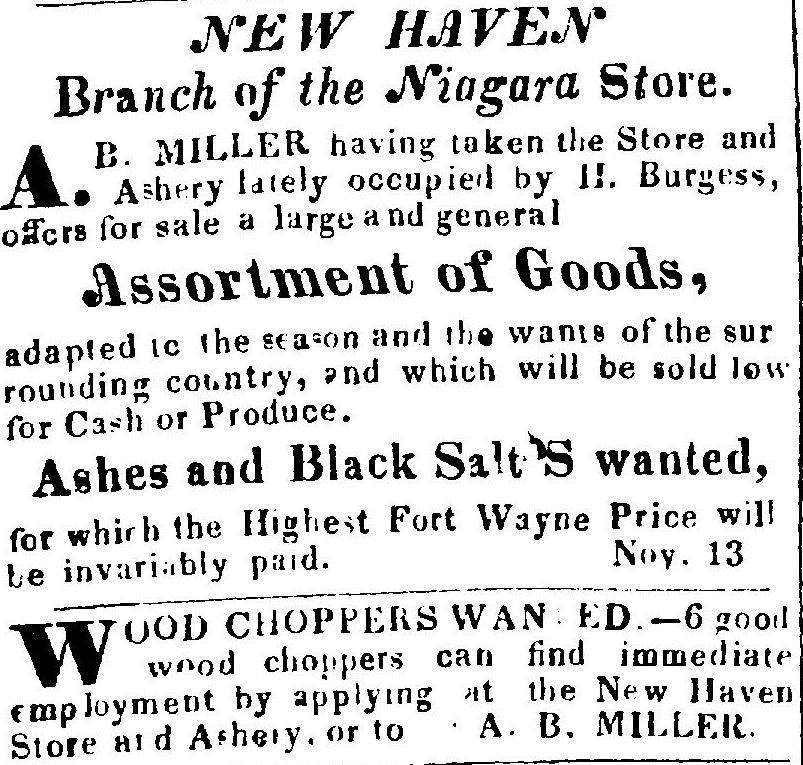
  • A newspaper notice headed New Haven, Branch of the Niagara Store: A. B. Miller having taken the Store and Ashery lately occupied by H. Burgess offers for sale a large and general Assortment of Goods. Below, Ashes and Black Salts wanted, and Wood Choppers Wanted at the New Haven Store and Ashery.

    Allen County

    Its house of Burgesses

    Henry Burgess laid out New Haven along the canal in 1839, kept its first store and ashery, and moved the post office there. In 1842 the Sentinel said he got that office by the removal of a neighbour. In 1866 he built the Methodists a brick church.

All four pieces in Builders

Business

A rival canal line, the scrip a farmer was paid in, the ashes he sold by the ton, and the first likenesses taken in the town.

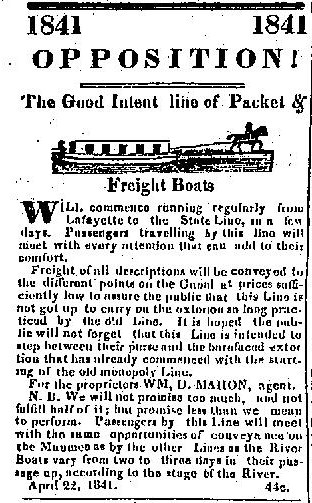
  • A newspaper advertisement headed 1841 at both corners and OPPOSITION! in wide capitals. Beneath it, The Good Intent line of Packet and Freight Boats, with a small woodcut of a long cabin boat towed by a horse with a rider. Two paragraphs of small type follow, signed for the proprietors by Wm. D. Mahon, agent, and dated April 22, 1841.

    Fort Wayne

    Opposition on the canal

    In April 1841 William D. Mahon headed his canal advertisement with one word, OPPOSITION, and promised to step between the public's purse and the old line's extortion. By January his horses and harness had been attached.

  • Fort Wayne

    The value in this market

    At the end of August 1843 two Fort Wayne merchants set out the paper a farmer might be handed across their counter. A dollar in old scrip bought 85 or 90 cents of goods that week. A dollar in Blue Dog bought 40. Nobody would put a number on the Blue Pup.

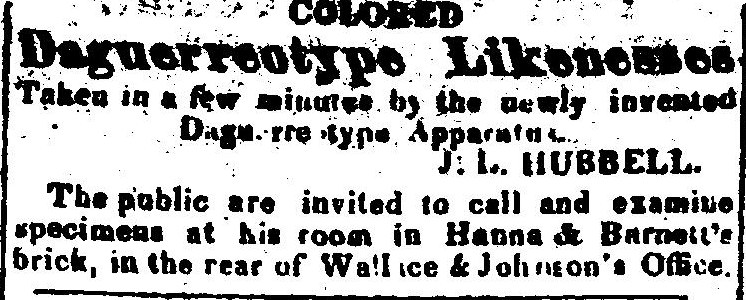
  • A small newspaper advertisement. The word Colored in small capitals sits over Daguerreotype Likenesses in heavy decorated type, then: Taken in a few minutes by the newly invented Daguerreotype Apparatus, signed J. L. Hubbell. A last line invites the public to examine specimens at his room in Hanna and Barnett's brick, in the rear of Wallace and Johnson's office.

    Fort Wayne

    As true to nature as the reflection in a mirror

    In the autumn of 1843 Charles E. Keith took rooms in a brick building in Fort Wayne and set out a camera. Four weeks later the town had a daguerreotypist of its own, and the editor of the Sentinel said the same thing about both men's likenesses: as true as a mirror.

All four pieces in Business

Schools

A school tax the city voted down, a seminary meant to run on court fines, a college its sheriff put up for sale, and a schoolhouse nobody could reach.

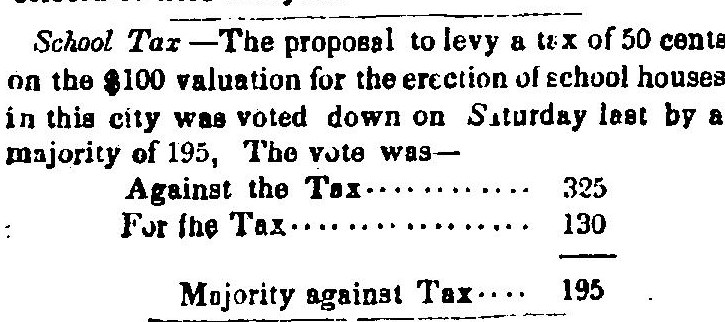
  • A short newspaper paragraph headed School Tax in italics. It reports that the proposal to levy a tax of 50 cents on the $100 valuation for the erection of school houses in this city was voted down on Saturday last by a majority of 195. Below, a small table: Against the Tax, 325. For the Tax, 130. Majority against Tax, 195.

    Fort Wayne

    More than they are either able or willing to bear

    In June 1853 Fort Wayne had 1,200 school children and no public schoolhouse. The editor of the Sentinel wrote that a school tax might be more than the city could bear, and the voters turned it down, 325 to 130. Five years later he was elected a school trustee.

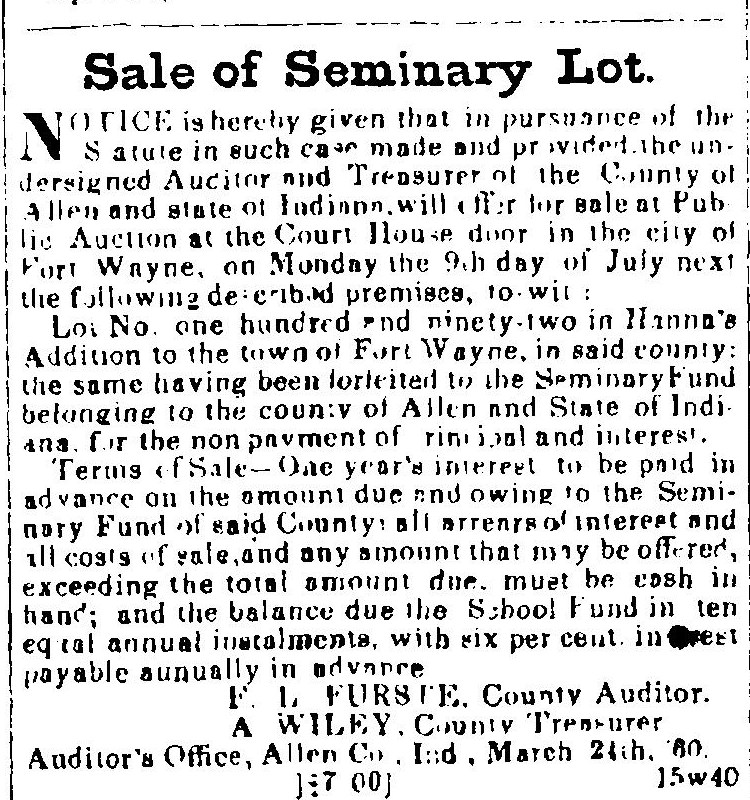
  • A newspaper notice headed Sale of Seminary Lot in bold type. The text announces sale at public auction at the Court House door on Monday the 9th day of July of lot number one hundred and ninety-two in Hanna's Addition, the same having been forfeited to the Seminary Fund for the non payment of principal and interest. It is signed by F. L. Furste, County Auditor, and A. Wiley, County Treasurer, and dated March 24th, '60.

    Fort Wayne

    A total loss to the Seminary Fund

    The county's first school was meant to be paid for by the fines of its courts. In 1841 the clerk counted $3,392.70 in fines and forfeitures since 1824, and $238.31 collected. In 1860 one of the seminary's lots was forfeited back to the fund.

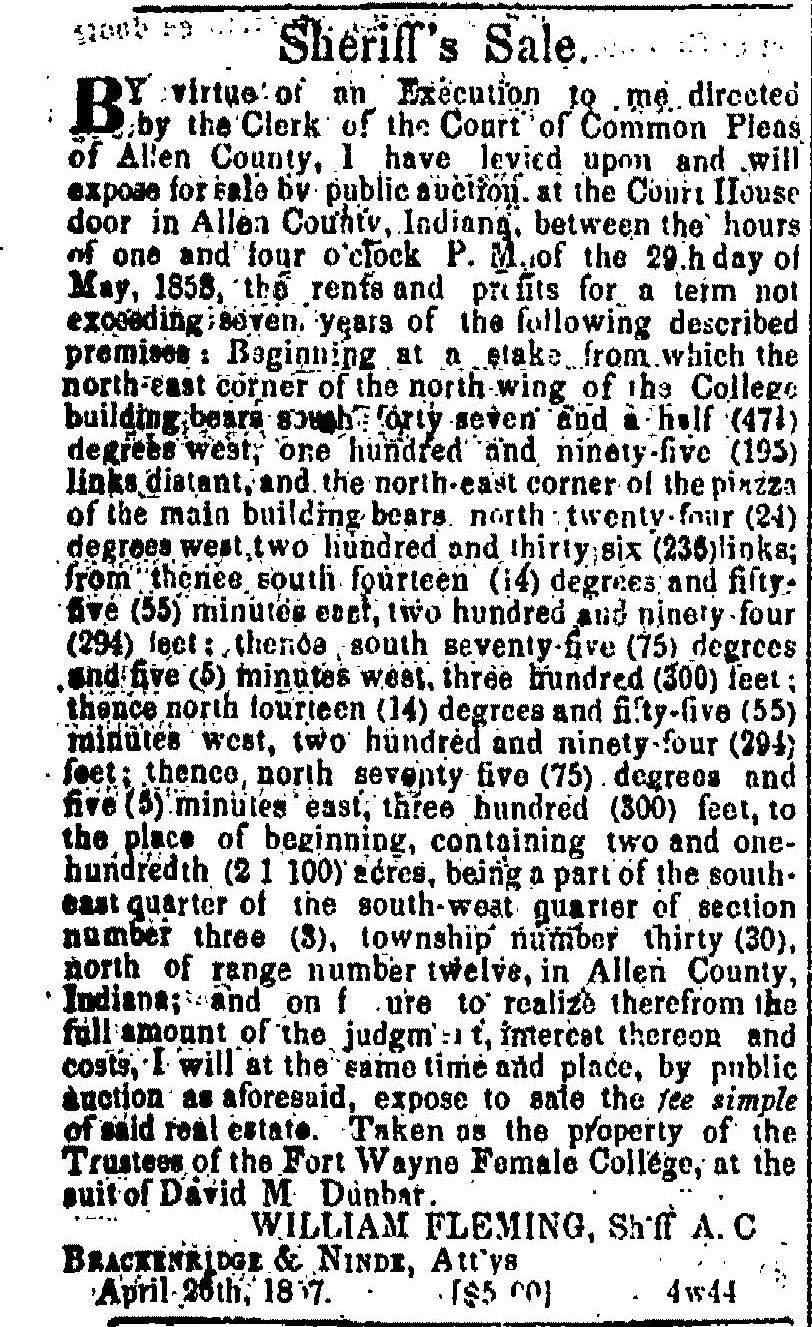
  • A long newspaper notice headed Sheriff's Sale. A single column of small type describes a tract measured from the north-east corner of the north wing of the College building and the piazza of the main building, two and one hundredth acres, and ends: Taken as the property of the Trustees of the Fort Wayne Female College, at the suit of David M. Dunbar. It is signed William Fleming, Sheriff, with the attorneys Brackenridge and Ninde, and dated April 26th, 1857.

    Fort Wayne

    Taken as the property of the Trustees

    In June 1847 a procession laid the corner stone of the Fort Wayne Female College at the end of West Wayne Street. Eleven years later the sheriff offered the same ground for sale at the suit of David M. Dunbar, and the paper never said what happened next.

All four pieces in Schools

The maps

Seven sheets of this county, drawn between 1803 and 1898.

Pick a township

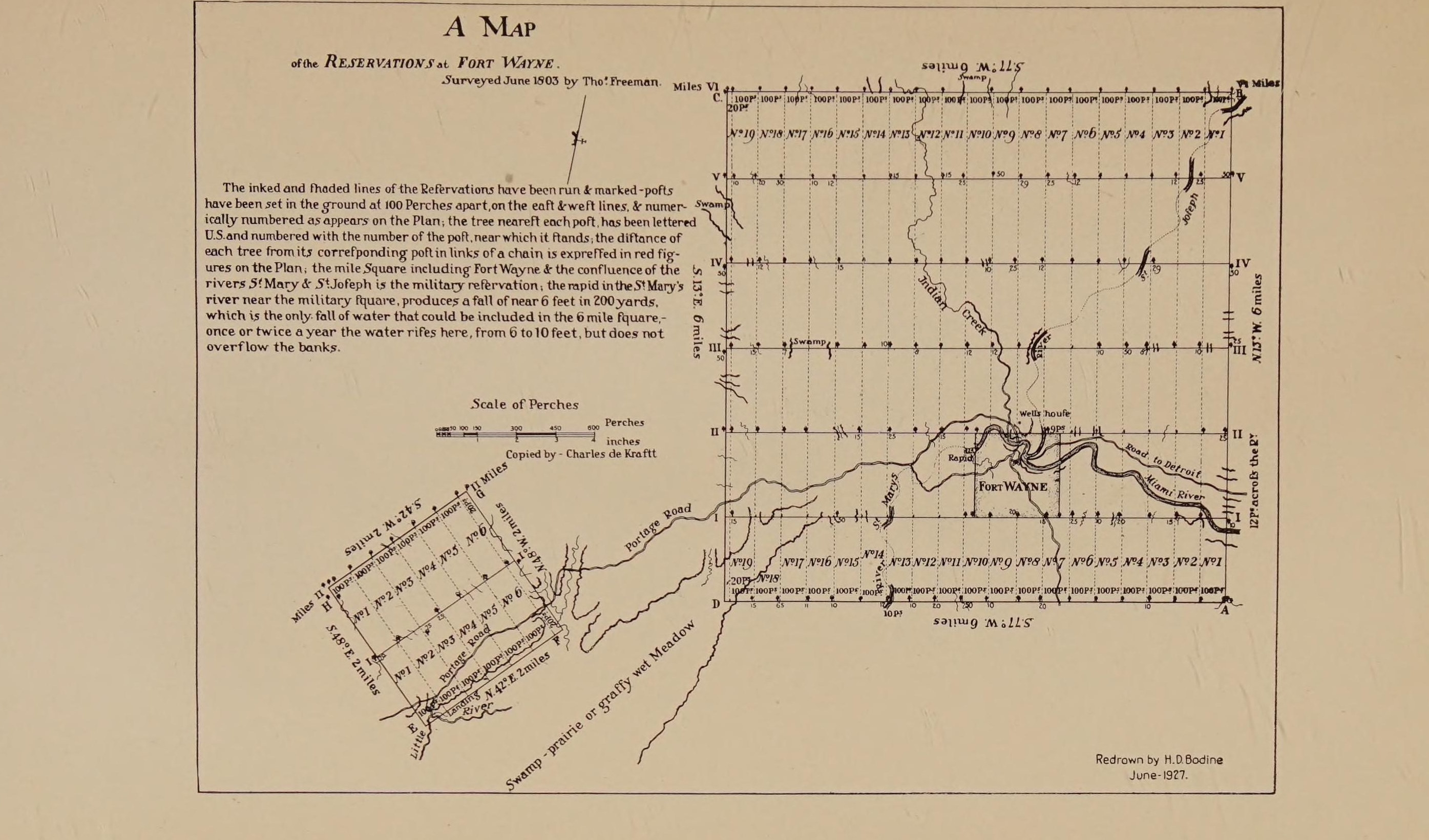
A map of the reservations at Fort Wayne, surveyed June 1803

Fort Wayne, Gateway of the West, 1802-1813, edited by Bert J. Griswold, Indiana Historical Collections volume XV, 1927, the plate facing printed folio 132, scan leaf n154.. Internet Archive.

Ten plates out of four county books, each cropped to its own printed border and captioned exactly as the sheet prints it. Six of them were paid for by the person in them.

Look at the plates

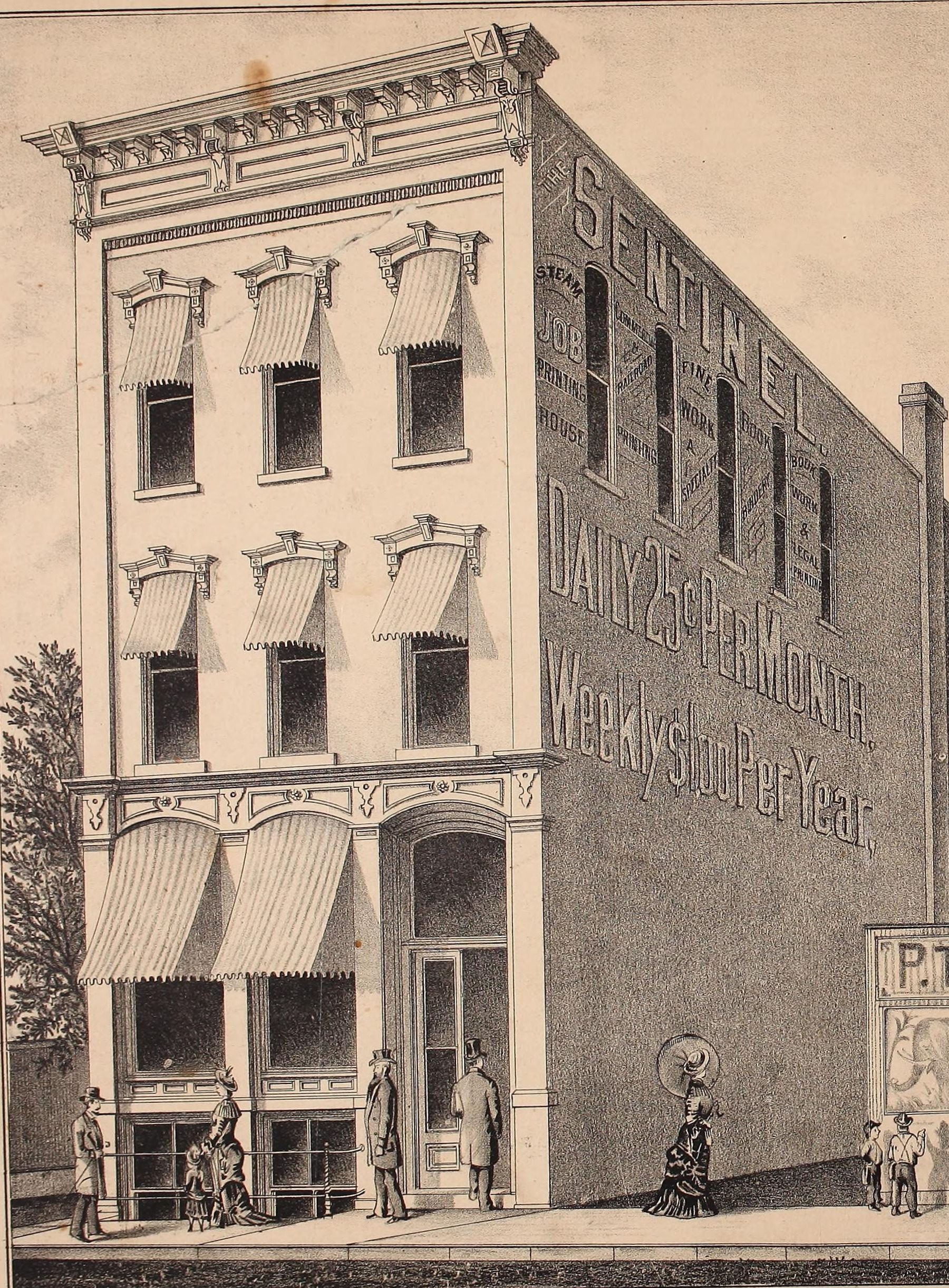
The Fort Wayne Sentinel

History of Allen County, Indiana, 1880, leaf n131. Public domain. Published before 1929, so out of copyright in the United States.

The county

  • Aboite Township, No pieces set here
  • Adams Township, No pieces set here
  • Cedar Creek Township, No pieces set here
  • Eel River Township, No pieces set here
  • Jackson Township, No pieces set here
  • Jefferson Township, No pieces set here
  • Lafayette Township, No pieces set here
  • Lake Township, No pieces set here
  • Madison Township, No pieces set here
  • Marion Township, No pieces set here
  • Maumee Township, No pieces set here
  • Milan Township, No pieces set here
  • Monroe Township, No pieces set here
  • Perry Township, No pieces set here
  • Pleasant Township, No pieces set here
  • Scipio Township, No pieces set here
  • Springfield Township, No pieces set here
  • St. Joseph Township, No pieces set here
  • Washington Township, No pieces set here
  • Wayne Township, No pieces set here

Twenty townships. The dashed line is Fort Wayne's city limits today, not the town at any earlier date. The count is where a piece is chiefly set.

Where to go and see it

Two organisations in this county keep the ground and the record that most of the history here is written from. Both are open to anybody who turns up.

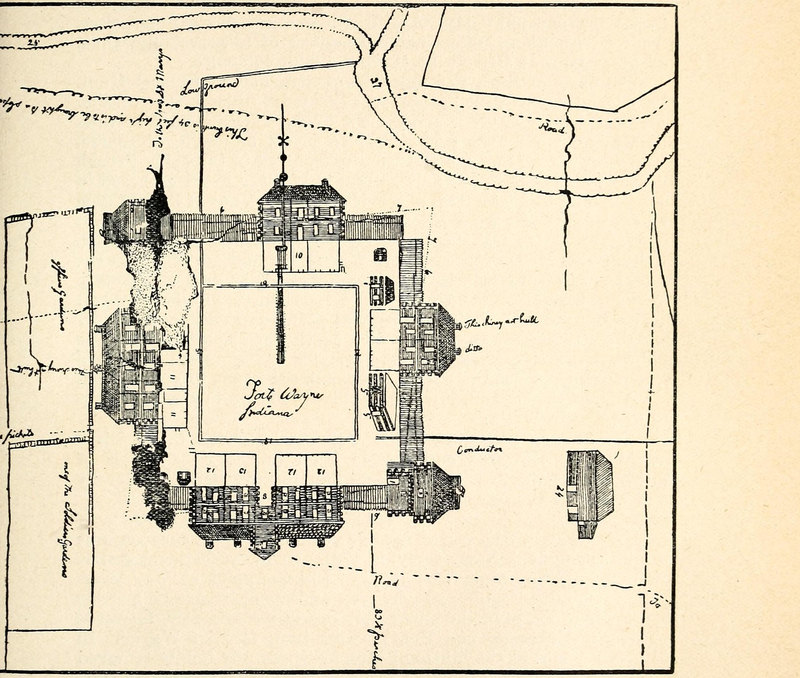
  • Major Whistler's plan of the fort drawn from above: a picket square with a blockhouse at each corner, the buildings ranged inside it, and the river running past one face.

    The Old Fort

    Run by Historic Fort Wayne, Inc.

    A full-size reconstruction of the post American troops built under Major John Whistler in 1815, standing less than a quarter of a mile from where the original stood. Whistler's own drawing of that fort is in this archive's Maps section, dated August 1816 by the 1917 history that printed it and 1815 by the library that holds the sheet.

    The Pictorial History of Fort Wayne, Indiana, by B. J. Griswold, 1917, printed page 157, scan leaf n164. Internet Archive. Public domain. Published before 1929, so out of copyright in the United States.

    The Old Fort
  • The chapter's mark: a blue and red emblem of the Sons of the American Revolution.

    Anthony Halberstadt Chapter, Sons of the American Revolution

    Fort Wayne, Indiana

    A lineage society whose members are proven descendants of men who fought for American independence, working in Fort Wayne through education, patriotic service and historical preservation. It is named for a Hessian soldier captured at Trenton on the morning after Washington crossed the Delaware, who then joined the American side and served as a teamster for the rest of the war.

    The mark of the Anthony Halberstadt Chapter, used by permission of the chapter.

    Disclosure: the publisher of the Standard is this chapter's secretary and built its website. Listings are free and are never sold. How we handle this.

    Anthony Halberstadt Chapter, Sons of the American Revolution

Support The Standard

Nothing on this site is behind a paywall, nothing on it is sponsored, and there are no advertisements on it and never will be. If it has been worth something to you, there are three ways to give something back, and only one of them involves money.

Support The Standard